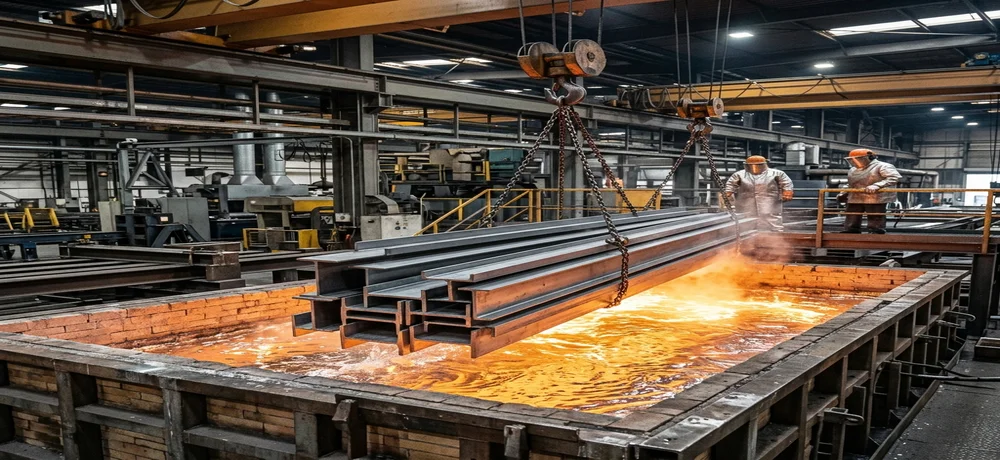
If you see a highway guardrail, a power transmission tower, or a pipeline full of industrial equipment, you're most likely gazing upon hot-dip galvanized steel. While it may look like bare metal, under that silvery exterior is one of the best anti-corrosion technologies ever developed. So, if you're in an industry that uses structural steel, At Radadia Engineering the hot dip galvanizing plant is the key to keeping your steel safe, and knowing why this is true begins by understanding the cost of rust.
Corrosion is no cosmetic issue! It is estimated that the cost of steel corrosion for industries in the world today, due to structural failures, replacement costs and safety incidents, is in the trillions of dollars annually. Selecting the appropriate protective coating for steel is far more than a technical move for engineers, architects and procurement managers. It's a monetary and safe one.
What is “Hot Dip Galvanizing” – and how does it work?
The hot dip galvanizing process involves immersing fabricated steel into a molten bath of zinc at about 450°C (840°F). This is not a merely superficial adhesion; it is a metallurgical bond. As the zinc comes into contact with steel, a series of zinc-iron alloy layers is formed, with a layer of pure zinc on top. This leaves an unmistakable coating on the steel, but more importantly, one that is integrated into the steel.
This is important because paint and spray coatings are placed on the surface of the steel. Over time, they may chip, peel or crack, particularly due to mechanical stress or UV rays. Galvanizing, on the other hand, is a part of the structure of the steel. It will not come off easily and, when only small areas are damaged, zinc will corrode before the steel, protecting it. This is called cathodic protection and is one of the strongest reasons for galvanized steel being superior to other selections in outdoor and aggressive settings.
Inside Hot Dip Galvanizing Plant "Radadia Engineering"
A well-run galvanizing operation is not just a zinc bath; it is a well-planned process, and each step is crucial. Steel galvanizing is a rigorous process carried out in Radadia Engineering's plant to ensure consistency, quality and adherence to IS 2629 & ISO 1461 standards.
Degreasing & Surface Cleaning
Steel is delivered with mill scale, oils, and contaminants. Alkaline degreasing baths are used to remove organic material from the surface so the zinc will adhere to the metal. This covers the most often overlooked step — most coating failures are attributed to poor cleaning.
The process of pickling in Hydrochloric Acid
Scale and rust are removed by immersing steel in a dilute HCl solution. With careful timing, the acid will dissolve the iron oxides, but not the steel. Rinsing of tanks will prevent acid carry-over to the next step.
Fluxing
Steel is immersed in a zinc ammonium chloride flux solution. This last pre-treatment is intended to get rid of any remaining oxides and provide an optimum reactive surface for zinc adhesion — before re-oxidation occurs before the steel reaches the zinc bath.
Place the part in Molten Zinc. Dip in Molten Zinc
The steel is lowered into the galvanizing kettle at ~450°C and in just a few minutes, the metallurgical reaction between the iron and zinc starts to create the characteristic layers of alloy. The time of immersion is adjusted according to the thickness and shape of the steel.
Quenching & Inspection
Withdrawal is followed by a water or air quench. Coating thickness (using magnetic gauges), surface finish, and adherence are all checked by our QC team, and all results are recorded and traceable.
The Durability Advantage: How Galvanized Steel Lasts Longer than the Alternatives
However, a few important points emerge from the comparisons that project owners can make between galvanized steel and other possible materials such as epoxy coatings, paint systems, or stainless steel.
One is that galvanizing can provide full coverage. The interior surfaces of hollow sections, sharp corners, welds, and recesses are coated with the same protection as flat faces, as the steel is dipped in liquid zinc. Spray coatings typically fail to cover these important areas. Secondly, in most environments the coating does not need to be maintained for decades. In India, we galvanize infrastructure at a quality galvanising plant, and it can routinely last for more than 50 years without touch-up, even in rural areas or semi-industrial settings.
Third, and often surprising, galvanized steel is often more cost effective over the life of the structure. Most of the cost premium for the initial painting of an alternative compared to raw steel will be recouped in the first maintenance cycle. In the case of major infrastructures such as transmission towers, bridges, or agricultural buildings, this can result in millions of rupees in maintenance cost savings.
INDUSTRY APPLICATION SPOTLIGHT
Radadia Engineering provides hot dip galvanized structural steel for power transmission, telecom towers, road infrastructure, solar mounting structures and industrial fabrication industries. We have the capability to process large fabricated assemblies as well as processing high volume batch runs with zinc coating thickness from 45 µm to 150 µm depending on application needs.
A high level of corrosion resistance, across environments
All environments are not the same in the degree of aggressiveness towards steel. The use of zinc coating for steel is especially beneficial in the following:
Coastal and marine areas – where salt-laden air will greatly speed the rate of oxidation. Galvanized steel will serve reliably in a coastal environment, where most paint systems last only 5 years. Zinc's passivation behaviour naturally provides a buffer to the industrial atmosphere where SO₂ or chemical exposure is required and cannot be degraded. Galvanizing can be applied underground with earth electrode and structural piles and is highly advantageous, as it protects steel from both soil moisture and electrochemical attack.
As a rule, we're constantly recommending clients on the specification of the coating they should use for the operating environment, as the zinc thickness that might be useful for operating a power tower in a coastal area would be different from that which would be required for an operating building structure on a mezzanine.
The bottom line: Galvanizing is not an expense; it's an investment
Steel's main role is to bear loads, span distances and support structures that are indicative of modern infrastructure. However, its future performance is solely dependent on its protection from the environment it is exposed to. When a properly managed hot dip galvanizing plant (process control, quality inspection, correct zinc specification) applies metal to a structural steel element, it is not just an ordinary piece of metal anymore, it is now a product that can provide many years of trouble-free service.
At Radadia Engineering, we see each batch as a promise to a project that will be used for. From steel for a transmission line in coastal Gujarat to a solar structure in the deserts of Rajasthan, our galvanizing process guarantees that your steel is not only protected but also certified and ready to endure. Talk to our technical team today – let's create something that lasts.
